
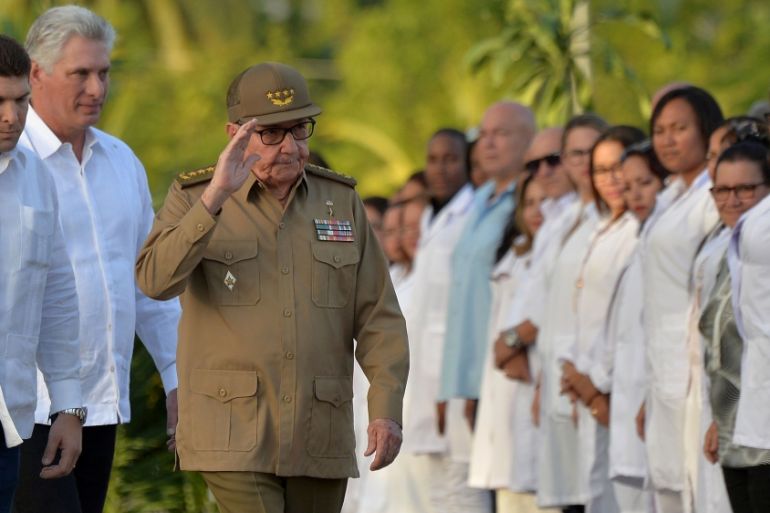
Cuba has celebrated the 60th anniversary of its communist revolution with its leader Raul Castro criticising the United States for returning to an outdated path of confrontation with the island nation.
Castro, who stepped down as president in April but remains the leader of the Communist Party until 2021, spoke on Tuesday in Santiago de Cuba at the grave of his brother Fidel Castro, Cuba’s revolutionary leader who died in 2016.
Recommended Stories
list of 4 items- list 1 of 4United Nations calls for end to US embargo on Cuba, again
- list 2 of 4Cuban lawmakers vote in new five-year term for current president
- list 3 of 4US to allow more flight routes to Cuba in latest restriction lift
- list 4 of 4Cuba has a new leader and it’s not a Castro
“Increasingly, senior officials of [US President Donald Trump‘s] administration, with the complicity of some lackeys, disseminate new falsehoods and once again seek to blame Cuba for all the ills of the region,” he said in the presence of Cuba’s current President Miguel Diaz-Canel.
After the restoration of diplomatic ties and a friendlier tone under the former administration of US President Barack Obama, “once again the US government seems to take the course of confrontation with Cuba”, he said.
Clad in military fatigues and cap, the 87-year-old Castro said that Cuba had proven throughout six decades of revolution it could not be intimidated by threats. Instead, it remained open, he said, to peaceful and respectful coexistence.
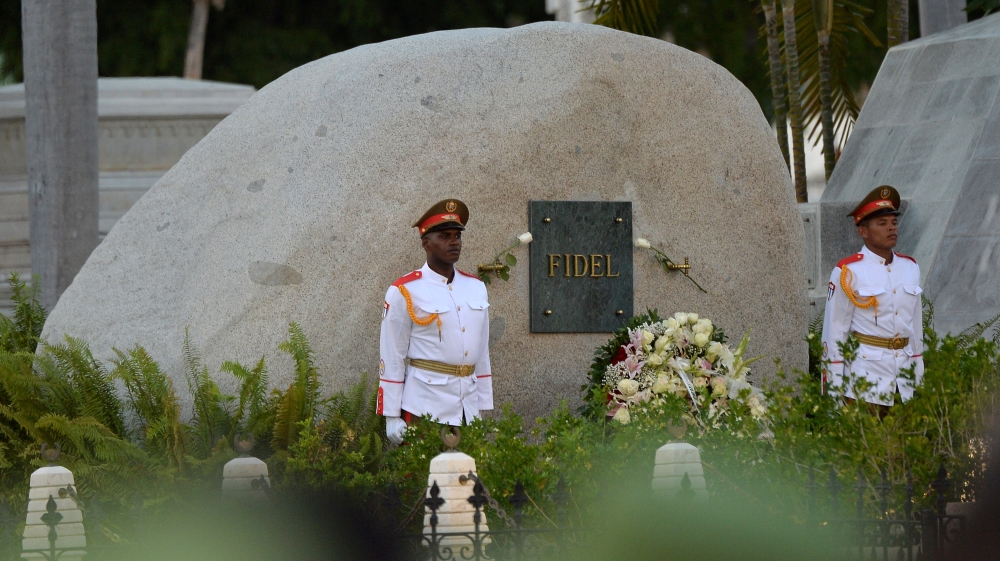
On January 1, 1959, Fidel Castro overthrew a US-backed authoritarian leader Fulgencio Batista and installed a Communist-run country on the doorstep of the United States, setting the scene for decades of Cold War hostility.
Currently, Cuba remains one of only a handful of communist states left in the world, and has been under a US economic embargo since 1962.
Abroad, Cuba’s government has faced heavy criticism for its authoritarian nature, intolerance of opposition, and persecution of detractors.
Trump’s national security adviser, John Bolton, said in November that Washington would take a tougher line against Cuba, Venezuela and Nicaragua, calling them a “troika of tyranny”.
