
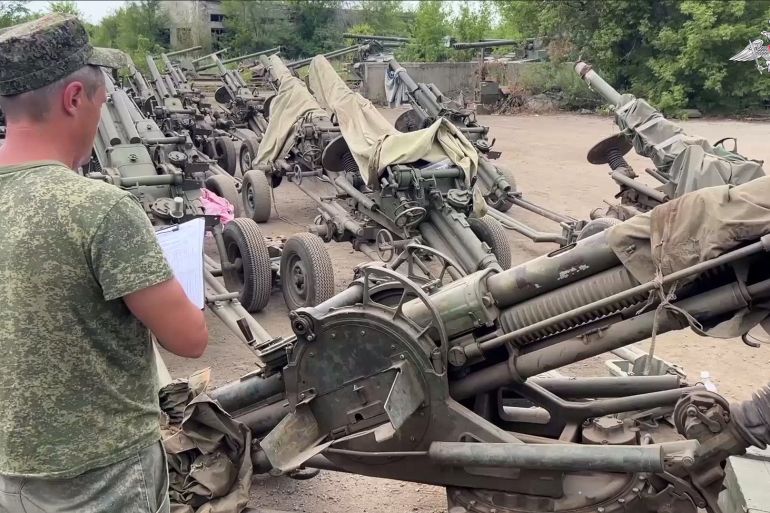
The Wagner mercenary group is completing the handover of its military hardware and weapons to the regular armed forces, according to Russia’s Ministry of Defence, two weeks after a short-lived mutiny that saw its columns advance on Moscow.
The ministry announced on Wednesday it had received more than 2,000 pieces of military hardware, including tanks, mobile rocket launchers and anti-aircraft systems.
Recommended Stories
list of 4 items- list 1 of 4Trump announces two-week ceasefire as Iran agrees to reopen Hormuz Strait
- list 2 of 4Russia confirms 16 Cameroonian soldiers killed in Ukraine war
- list 3 of 4Taiwanese opposition leader to meet China’s Xi in a test of diplomatic skill
- list 4 of 4Iran war: What is happening on day 39 of US-Israeli attacks?
It said it had been given “more than 2,500 tonnes of various types of ammunition and about 20,000 small arms”. Much of the equipment, it said, had not been used in combat before.
The disarming of Wagner reflects efforts by the Russian authorities to defuse the threat posed by the private army and its founder Yevgeny Prigozhin, although uncertainty remains about his fate.
Under the terms of the deal that ended the rebellion he was supposed to go into exile in Belarus, but Belarusian President Alexander Lukashenko said last week that Wagner soldiers remained in their camps and Prigozhin was in Russia.

Putin has said that Wagner troops were required either to sign contracts with the defence ministry, move to Belarus or retire from service.
The defence ministry, which released photos of the equipment in undisclosed locations, said the Wagner weapons had been transferred to rear positions where the equipment can be maintained or repaired.
The armed group, which played a key role in the Ukraine offensive, sought to topple Russia’s military leadership during the rebellion, which was over in less than 24 hours.
At the time, Putin condemned the revolt as an act of treason and threatened severe punishment for those who took part, but the criminal case against Prigozhin was dropped hours later as part of the deal. At the same time, the Wagner chief apparently could still face prosecution for financial wrongdoing or other charges.
The rebellion represented the biggest threat to Putin in his more than two decades in power, even though Prigozhin, long seen as close to Putin, insisted the uprising was not aimed at the president but at Defence Minister Sergei Shoigu and chief of the military’s General Staff, General Valery Gerasimov.
Both men remain at their posts.
At the same time, uncertainty surrounds the fate of General Sergei Surovikin, the deputy commander of Russian forces fighting in Ukraine, who reportedly had ties to Prigozhin.
Andrei Kartapolov, a retired general who heads the defence affairs committee in the lower house of the Russian parliament, said on Wednesday that Surovikin was “resting” and “not currently available”, but declined to elaborate.